
Alternatives to Hacker Rangers: gamification is not a simulations program

Hacker Rangers builds culture with games, rankings and comics. Anyone searching for alternatives to Hacker Rangers already needs to measure real exposure: a click, a QR, a report. An activity ranking is not a risk score. The game is not a simulation.

Why people search

Why teams search for alternatives to Hacker Rangers when they need to simulate

It is not a rejection of gamification

It is the day the CISO asks “who would fall for a treasury phish this week?” and the available answer is a points leaderboard, a finished comic or a challenge streak. That measures engagement. It…

Hacker Rangers, on the public evaluation we use, does not run

It is a playful training program. As a culture program it can be powerful. As a human-risk program it is blind on the side of behaviour in front of a lure. Whalemate simulates email and QRishing…

“Ranking” sounds like healthy competition

An activity ranking does not say who is risky. It says who played. Whalemate’s Human Risk Score is built on behaviour in front of simulations and training, and it is used to intervene. Mixing the two…

HR and communications love comics and games

Security needs a cycle. When both buy the same vendor expecting different things, the contract becomes a KPI fight. An alternative to Hacker Rangers, here, is the cycle. It is not “the same game…

Criteria

Criteria: engagement versus real exposure

Four axes. The first is enough to decide. The others stop you buying an LMS dressed as an arcade and believing you already have phishing.

There is a simulation or there is a game

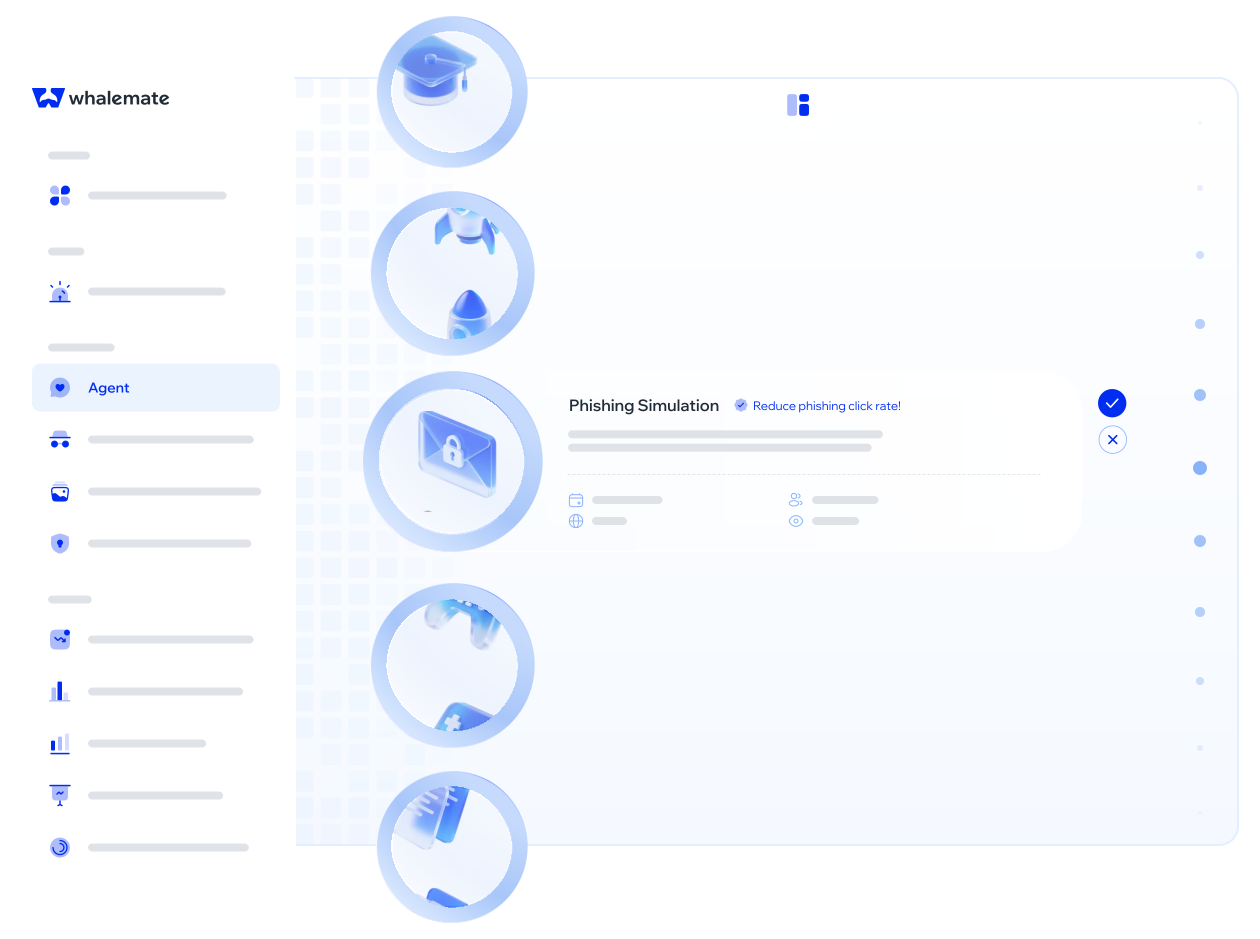
Whalemate. There are native email and QRishing simulations. Smishing, vishing, USB, 2FA and deepfake run as a service. The lure exists. The click is measured.

Hacker Rangers. No simulations of any vector. The program trains and entertains. It does not put the person in front of a controlled lure.

Risk score or activity ranking

Whalemate. The index is human risk per employee. It is not published as a shame podium.

Hacker Rangers. Rankings measure who took part, who won, who held the streak. That is culture. It is not exposure.

Incident and report

Whalemate. The report button and the inbox live in the cycle. A user’s false positive is a program datum.

Hacker Rangers. No phishing-incident management as a product. The reporting gesture is not the centre: the game is.

Agent and paths tied to risk

Whalemate. The agent plans. Paths move with the profile. Trivia exists as a short format, not as the whole product.

Hacker Rangers. No agent. Paths, if they exist, are not tied to a risk index because that kind of index is not the object.

The referent

Security culture is not a points ranking

Hacker Rangers is bought so people play at learning cybersecurity

That cut is legitimate. There are organisations where the long course will not fit —healthcare with shifts, retail with branches— and a playful format holds the habit. Whalemate also has trivia…

A games program with no simulations does not answer the exposure

You can have the best comic in the category and still not know who opens the attachment from a fake vendor. Hacker Rangers does not cover that gap. It is not a hidden defect. It is the product design.

There is also no native Slack or Teams agent in the sense of a cycle

The contrast with Whalemate is not “they have no chat”. It is that there is no awareness agent that moves the plan when a profile’s risk rises, because there is no index of that kind to feed.

We do not try to beat Hacker Rangers at comics

They win there. The point is that a CISO should not sign a culture program believing they signed a phishing program.

Where they still win

Where Hacker Rangers wins, and it is right to let them win

They win at gamification as a product

Whalemate has a short format and competition between areas. It does not have a comics universe as a brand proposition. If the buyer is organisational culture and the KPI is participation, Hacker…

They win when there is no mandate to simulate

There are boards that still do not want to “phish the people”. Under that mandate, a game is politically easier. The cost is exposure blindness. That belongs in the minutes, not in an attack on the…

If what you need is engagement and you already have simulations

The risk is paying for two programs that do not talk: the game does not feed the index, the index does not feed the game.

Fit

Who should stay in a games program

The filter is the question the board already asks, not the one HR prefers.

Stay if the mandate is culture, not exposure

If nobody is going to simulate and the goal is to talk about cybersecurity without fear, the game is the right product.

Stay if the KPI is participation

Streaks, points and comics move engagement numbers. A CISO who only asks “that people play” will be satisfied.

Switch if they already asked who would fall

That question requires a controlled lure. The ranking does not answer it. That is where an alternative to Hacker Rangers starts to make sense.

Switch if you have to evidence an incident

With no inbox and no simulation, the post-mortem of a real phish has no prior cycle to show. It only has a game score.

The change

How to combine trivia with simulations without mixing the numbers

The change is not “kill the game”

It is putting the game in its place. In Whalemate, trivia holds the habit between cycles. The simulation measures exposure. The course leaves standards evidence. Three objects. Three numbers. If the…

The second change is introducing the lure

Native email and QR. The rest, service. Cultural onboarding can still exist. It is no longer the only rite.

The third is internal owners

HR can keep watching participation. Security watches the index. Reports are not mixed into a single public ranking. That discipline is part of the switch, not a UI detail.

In the demo

What you will see in a demo

In thirty minutes you see an email or QR lure and the index it produces

Without turning a trivia score into a risk score. The short format exists (trivia, ranking by area, Quick Check). The program is explained by the cycle.

Staying on Hacker Rangers is enough when the problem is that nobody

It becomes a problem when the comic is presented to the board as “we already have awareness” and there is not a single phishing exercise in the year. High engagement is true. Exposure still has no…

Hacker Rangers is not guilty of that use

The program that uses the game as its only evidence is. In the demo you see the contrast on your roster.

In the cycle

The change is adding the lure, not killing the game

If you are looking for alternatives to Hacker Rangers, the gap is simulation. Whalemate also has a short format; it is not “the same game, another logo”. The first step is seeing how an email or QR is simulated, not how…

The change is adding the lure, not killing the game
Questions

Questions about alternatives to Hacker Rangers

Doesn’t Whalemate have gamification?
Yes: trivia, ranking by area and Quick Check. Hacker Rangers’ gap is not “games are missing”: it is that there are no simulations.
Does Hacker Rangers simulate phishing and we missed it?
On the public evaluation we use, there are no simulations of any vector. Today the product design is playful training. If that changes, this comparison updates.
Is their ranking a risk score?
No. It is activity and competition. A risk score is built on behaviour in front of a lure and on training, and it is used to intervene. Mixing them is the error of this comparison.
Can I use Hacker Rangers for culture and Whalemate to simulate?
You can. The risk is two programs that do not talk. The index is not fed by someone else’s game. The cleaner case is a single cycle with the short format included.
Does this look down on comics and games?
No. They win that ground. The contempt would be pretending the comic measures exposure.
Is there a case of someone who left Hacker Rangers?
There is no public case with that story. We do not invent one. The contrast that can be claimed is engagement versus exposure.

If they already asked who would fall this week

In the demo we show an email or QR lure and the index it produces. Without turning a trivia score into a risk score.

We compare program approaches. We do not publish third-party prices, do not replace an RFP, and do not claim capabilities the product does not have on this site. Public sources reviewed in August 2026. Third-party capabilities may have changed.