ISO 27001 for everyone
Spanish · English · Portuguese
Video sections · Written lesson · Final quiz
Courses in Spanish, Portuguese and English, segmented by profile: everyone, technical, executives, operations and compliance. Reviewed at least once a year.
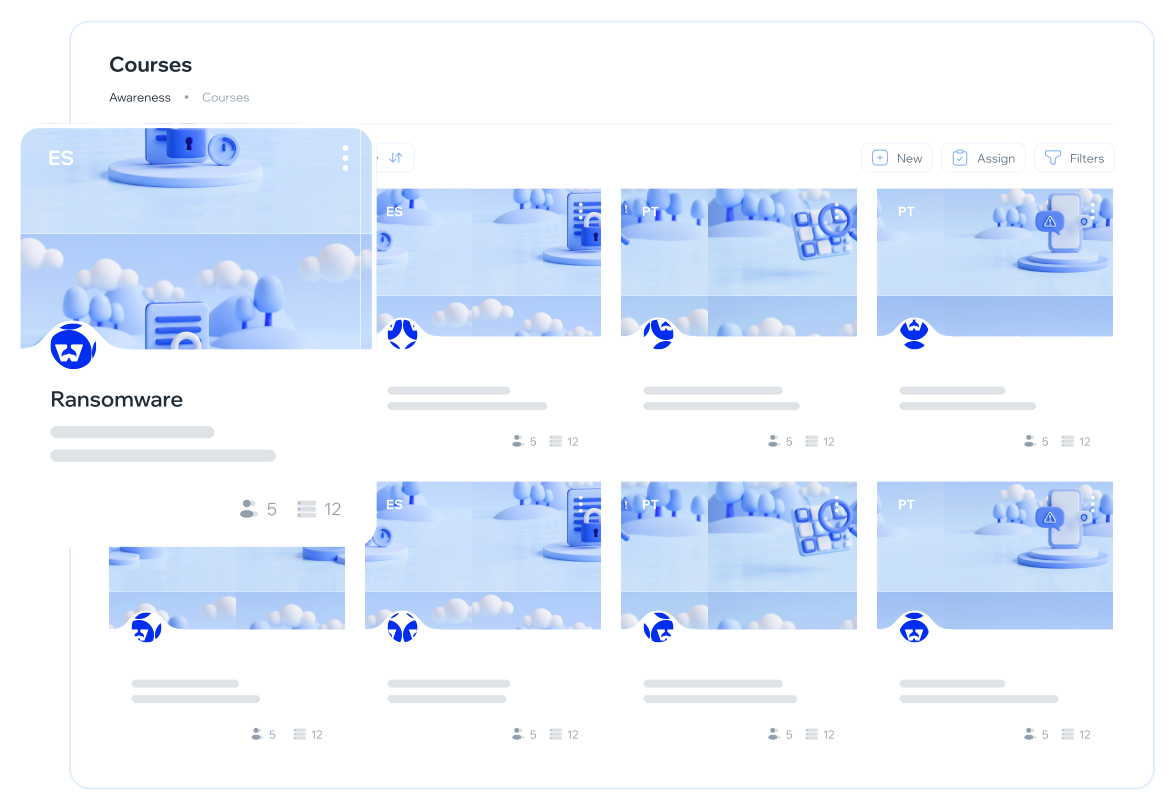
You filter everyone, technical, executives, operations or compliance; Spanish, Portuguese or English; and the topic. What you see here is the published compliance cut, not the full inventory.
Each course ships with video sections, a written lesson and a final quiz. Progress and pass live on the platform. If you export to an LMS, that is SCORM: another page. Here the course is taken and measured.
Every catalog course is reviewed at least once a year. It is not a “fresh content” marketing seal. It is policy: if a standard or a vector changed, the piece cannot still be the one from three years ago without a review pass.
Whoever passes can take a certificate. Whoever already runs an LMS can export the SCORM package. The certificate is not the full evidence of the program; it is the record of that course. Behavioural evidence still lives in analytics and simulations.
Spanish · English · Portuguese
Video sections · Written lesson · Final quiz
Spanish · English · Portuguese
Video sections · Written lesson · Final quiz
Spanish · English · Portuguese
Video sections · Written lesson · Final quiz
Spanish · English · Portuguese
Video sections · Written lesson · Final quiz
Spanish · English · Portuguese
Video sections · Written lesson · Final quiz
Spanish · English · Portuguese
Video sections · Written lesson · Final quiz
Spanish · English · Portuguese
Video sections · Written lesson · Final quiz
Spanish · English · Portuguese
Video sections · Written lesson · Final quiz
Spanish · Portuguese · English
Video sections · Written lesson · Final quiz
Spanish · English · Portuguese
Video sections · Written lesson · Final quiz
Spanish · English · Portuguese
Video sections · Written lesson · Final quiz
Avatar, voice and edit. This clip is not a course: no quiz, no pass. It is the same technique we use for the video sections. The Fede you see is synthetic.
The sample is in Spanish. Catalog courses ship in Spanish, Portuguese and English according to the filter above.
A course is taken and measured. This is watched: a sample of how we produce the piece.
It is the library the program assigns: short pieces, in the language of the person taking them, with a declared profile. Everyone does not read what an implementer reads. An executive does not need the OWASP lab. Operations needs the plant-floor gesture, not the ISO control written for audit. The catalog exists so that distinction is made before anyone hits assign.
It is not a loose PDF or a parked webinar. The video is taken as a course. The written lesson holds the criterion. The quiz leaves a score and a pass state. That is what an auditor can ask for and what People can show. We do not publish a total: commercial material says one figure and the listed catalog says another. Until they match, we do not invent a number.
The engine chooses what to send from behaviour. Here is what there is to send, who it is for and how it is kept current. What you see here is the compliance cut (ISO, PCI, OWASP and sibling standards), not the platform’s full inventory. If you want who gets reinforcement after a fail, go back to adaptive training. If you want the piece, the language and the profile, you are in the catalog.
Every Whalemate catalog course is reviewed at least once a year. The bar is not “refresh the intro”. It is running the piece against the current vector and standard: a Top Ten that changed year, a control an auditor no longer accepts as a 2019 video, a phishing example the roster already memorised. If the review did not happen, the piece is not presented as current.
You can load your own courses. They stay in your account. Other customers do not see them. They are for an internal procedure, a vendor, a brand or a risk the public catalog does not cover. Assignment and evidence work the same way. Content freshness is yours: the mandatory annual review is of the Whalemate catalog, not of your material.
The PDF certificate records name, course and pass. SCORM lets People run the same piece in the LMS they already use. Neither the PDF nor the package replaces the risk index or automatic assignment after a fail. If the LMS is the training record system, export. If the program has to react to behaviour, the course is taken here.
The same program does not send them the same piece. The catalog has that decision already made. People assigns by profile. Security does not build a deck per area. Compliance sees that the standard has a version for everyone, one for executives and one for whoever implements.
Custom courses live in your account, not in the public catalog. They are not mixed with ISO or PCI. The rest of the organization does not see them. The annual review policy applies to the Whalemate catalog; you maintain your own material, with the same assign and audit flow.
The catalog is the inventory. Adaptive security awareness training is the engine that decides which piece goes out, when and to whom, from behaviour. A phishing fail does not “open the campus”: it fires the contextual course. A low-risk profile is not saturated with the same annual pack. Without a catalog the engine has nothing to assign. Without the engine the catalog is another library nobody finishes. Compliance, AML/CFT and privacy have their own pages: the standard, the country, the data law. From here you reach those three. The assignment engine is still one.
In thirty minutes we look at profiles, languages and what gets assigned after a simulation. It is not a campus tour.